By Walter Jobs, Technology writer and editor. Manufacturer sources, competitor coverage and model scenarios reviewed 2 November 2026.
For a Core i5-12400F, compare the RX 9060 XT 16GB for a moderate graphics upgrade, the standard RTX 5070 for a specific NVIDIA-supported workload, and the RX 9070 XT for a larger graphics-heavy goal. Keep the six-core CPU when it already delivers your required frame-rate floor. A new graphics card is not an automatic reason to buy an i7 or replace the platform.
As an Amazon Associate we earn from qualifying purchases. This does not change the price you pay, and a commission never affects what we recommend. Full disclosure.
The right card depends on what you own and what the computer must do. A graphics-quality shortfall, a competitive minimum and an application feature requirement are different problems. Define the actual target before comparing products.
Graphics shortlist by upgrade need
| Product | When to compare it | Before buying |
|---|---|---|
| A moderate graphics purchase with 16GB memory | Compare the gain from the current card, not VRAM alone. Find offerson Amazon |
|
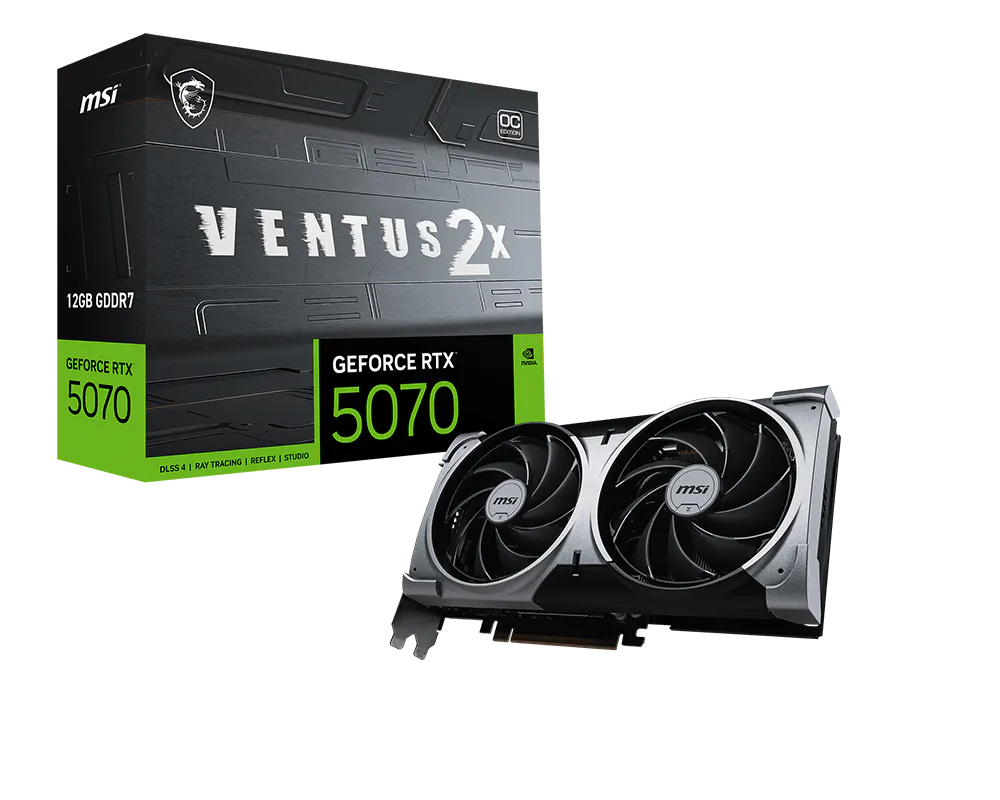 GeForce RTX 5070 |
A specific NVIDIA-supported feature or workload | Check the standard 5070 specification and actual software support. Find offerson Amazon |
| A larger graphics-heavy display or settings goal | Price case, power and any genuinely needed CPU upgrade together. Find offerson Amazon |
The larger candidate is not a requirement for the processor. Compare the owned GPU and the full installation cost. If a smaller change reaches the target, there is no need to increase the budget merely because a more expensive card appears in the table.
RX 9060 XT 16GB: a moderate step with a clear purpose
The 16GB RX 9060 XT is the first comparison when a moderate purchase can improve a much weaker current card. Verify the exact memory version, partner board and seller terms. An 8GB listing should not silently replace the 16GB product in your quote.
Capacity alone does not describe graphics processing performance. Compare measured results at the textures, resolution and effects you want. If your present card is already close enough to the goal, a larger memory number is not by itself a reason to buy.
RTX 5070: software needs can change the comparison
Consider the standard RTX 5070 when a supported feature or application path matters. Keep the 12GB standard card apart from the 5070 Ti. Assess actual software support rather than assuming that a brand badge supplies the advantage you need.
Generated-frame output should be separated from rendered base performance and game simulation. A high counter does not prove that the 12400F prepares unique game states at that same rate. Compare input response, frame pacing and image quality alongside the number.
RX 9070 XT: validate the larger graphics plan
The RX 9070 XT belongs in a comparison for a more demanding graphics workload or display. Include the exact board’s clearance, connections and PSU requirements in the cost. A GPU-only plan can become a broader installation project when those supporting parts need attention.
For high-refresh CPU-heavy play, seek measured evidence from the relevant difficult scenes. A compatible stronger card can still leave a CPU-side target unmet. Do not treat higher resolution as a guarantee that the processor can no longer limit a game.
Know the six-core LGA1700 baseline
| Manufacturer field | Published reference |
|---|---|
| CPU cores / threads | 6 / 12; six P-cores, no E-cores |
| Socket | LGA1700 |
| Official memory support | DDR4-3200 or DDR5-4800; motherboard-specific |
| CPU PCIe support | 5.0 and 4.0 |
| Processor Base / Maximum Turbo Power | 65 W / 117 W |
The 12400F has six P-cores and twelve threads, without the E-core configuration of some later i5s. Do not use a later hybrid processor’s core count as though it described this one. Extra cores also do not automatically establish a better gaming purchase.
The F model lacks integrated graphics. A motherboard video connector does not provide a display output from this CPU without a suitable discrete graphics path. That is useful to remember when troubleshooting an upgrade.
DDR4 versus DDR5 is a motherboard ownership decision
The processor supports either memory type in an appropriate board, but that does not mean a DDR4 motherboard accepts a DDR5 kit. Check the exact board’s specification and support list. A BIOS setting does not convert the physical memory platform.
If a DDR4 system is already working, compare its actual game performance before replacing the board and memory. A DDR5 platform quote belongs beside keeping the installation and making a supported CPU-only change. Do not assume that buying every part again is necessary for a graphics upgrade.
Which upgrade route fits the problem?
| Your situation | Best next comparison | Do not assume |
|---|---|---|
| Working DDR4 system meets the CPU target | Compare graphics-only upgrades | DDR5 support makes board and memory replacement mandatory. |
| A repeatable CPU-heavy scene misses the goal | Investigate supported CPU and configuration options | Another GPU tier guarantees a higher simulation rate. |
| New complete build | Compare whole-platform quotes and ownership needs | An owned-system saving transfers to buying every part new. |
Keep the complete quotes comparable. Include cooling, memory, motherboard and power changes wherever they are required. A CPU sticker price is not a whole-platform cost, and a GPU family price is not the cost of every retail cooler.
Modelled graphics tiers with the 12400F
| GPU | 1080p estimated FPS | 1440p estimated FPS | 4K estimated FPS |
|---|---|---|---|
| Radeon RX 6600 | 50 | 37 | 14 |
| GeForce RTX 5060 | 70 | 52 | 20 |
| Radeon RX 9060 XT 16GB | 77 | 57 | 33 |
| GeForce RTX 5070 | 115 | 86 | 50 |
| Radeon RX 9070 XT | 130 | 98 | 57 |
| GeForce RTX 5070 Ti | 131 | 102 | 59 |
At 1440p High, the generic model estimates 57 FPS with the RX 9060 XT 16GB, 86 with the RTX 5070 and 98 with the RX 9070 XT. These are calculated scenarios, not measured game results or a direct application-performance ranking.
The engine cannot reproduce every CPU-heavy scene, memory configuration, driver or PCIe link. Larger model outputs do not establish a universal maximum suitable GPU. Use the table as an initial screen, then seek evidence matched to the actual frame-rate floor and graphics settings.
Check the installed connection and the current shortfall
Read the board manual for the primary graphics slot, supported generation and electrical lane count. The processor’s maximum support is not a description of every slot. Check resource sharing with other installed devices when relevant.
Then diagnose a repeatable scene: rule out caps, abnormal temperatures, background tasks and memory configuration issues. Reduce graphics demand while keeping the scene comparable. Investigate the remaining problem before choosing a CPU or GPU upgrade. Our pairing guide explains the workload-first approach.
Research method and final checks
This is a specification-led editorial shortlist with PairMyRig scenarios. We did not test these combinations in a lab. Calculations use generic gaming, High preset and 32GB RAM, without measured named-game FPS, 1% lows, PCIe penalties, ray tracing or generated-frame results.
Primary reference: official Intel product specifications.
Read the model methodology for its limits. Use the PSU planner alongside the exact hardware instructions. The GPU pairing hub and upgrade-planning guide cover other starting points and staged purchases.
Explore another pairing scenario
Choose another graphics card. Select High preset and 32GB system RAM to match the table, and confirm the memory version of the selected GPU.
Frequently asked questions
Does the 12400F require a CPU upgrade before a new GPU?
No. Keep it when the CPU-heavy target is already met. Investigate a processor change only when the relevant workload and measured evidence justify the cost.
Can I put DDR5 into my existing DDR4 motherboard?
Not simply because the CPU supports both memory types. Check the exact board; DDR4 and DDR5 versions are different physical installations.
Is the RX 9070 XT automatically too much for the CPU?
A universal ceiling is not useful. Check compatibility, the graphics workload and CPU-heavy frame-rate floor. The larger card can fit one goal and be poor value for another.
Does the 12400F have E-cores or integrated graphics?
It has six P-cores without E-cores, and the F model has no integrated graphics. Use the exact processor specification when planning or troubleshooting.